Showing posts with label Science fiction films. Show all posts

Write What You Love...

One of the most cliched bits of advice given to young writers is to "write what you know." As a teenager I always laughed at that, because my favorite books involved dragons and robots and spaceships. Not exactly something your standard life experience prepares you to write about. Obviously, I was taking the advice a bit too literally—as writers, even speculative fiction writers, we're constantly writing what we know anyway. The decisions our characters make are reflections on the decisions we make in our lives. The traumas and battles are echoes of the fears we ourselves have. In many ways, I think we can't help but write what we know. What we know informs everything.

So that's not really what I'm here to talk about. Instead, I'd like to champion the idea of writing what you love.
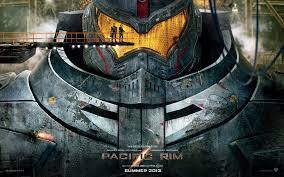
Yesterday I went to see Pacific Rim, a movie which I've been looking forward to for years, ever since I found out that Guillermo del Toro (Pan's Labyrinth) was doing a mecha/monster movie. For those of you who haven't been devouring every single interview and tidbit about the movie, it's basically a giant love letter to the kaiju genre (think Godzilla) of Japanese film, which he loved as a child.

And even though I was never into kaiju movies myself, it was probably the most thoroughly enjoyable movie I've seen in a long time. Every moment of it oozed love for the genre. I think I spent the entire movie with this big, ridiculous grin on my face because you could feel how much fun del Toro had making it. It got me thinking about how much better art is when we give in to doing what we love, writing what we really want to write about. And why on earth we'd waste any time doing anything else.

I've heard the same thing from so many aspiring writers (myself included): "What I'd really love to do is X, but..." There's always a reason not to. "I'm not good enough yet" was always my reason for not attempting to write what I really loved. But I've also heard "but there's no market for X right now" and "I don't know if anyone would want to read that."

There are always plenty of reasons not to try it. But the thing is, if you love it, that'll come through in your writing. It always does. Inevitably, readers' favorite parts of books are the parts I most enjoyed writing. When it's a labor of love, the rest falls into place.


The Feels and Science Fiction

Since today is my birthday, I've reserved the right to talk about two of my favorite things this year: Doctor Who and the way Zachary Quinto and Chris Pine look in tight uniforms the relationship between Kirk and Spock.

It's because of important, writerly reasons, I promise.

What I love about both of these things is how surprisingly emotional they are.  When I started watching Doctor Who, I thought I was signing up for campy, spacey fun, not hours of blinking tearfully at the screen, sad-babbling to my husband as I watched the Tenth Doctor regenerate.  Same with Star Trek: Into Darkness.  I thoroughly enjoyed the first installment (I typically enjoy all things J.J. Abrams) but I was not prepared for the EMOTIONS I had this time around.  Bromance emotions.

Sigh.

So how do they do it?  I don't have a definitive answer for this, and if I did, I'd open up a school called ALL THE ANSWERS FOR WRITING SCHOOL and rake in the cash.  But my theory is this: that both the show and the film take the time to focus on the characters.  What's fantastic about sci-fi is that you don't even realize that it's happening, because these important moments are generally happening while characters are doing things, running away from aliens and so forth.  Elements of backstory (that the Doctor once had a family or that Spock is still aching from the loss of his planet) happen while other plot elements are going on.  And our character's true motivations, their true capacities for fear/bravery/compassion/humor are revealed by the choices they make when in difficult situations.  By taking the time--seconds in screen time--to give us glimpses of character, they plant the seeds for a huge emotional payoff.  (Side note: Firefly and Lost are other examples of this being amazingly well-done.)

This is something that I'm not always able to put my finger on when it's lacking in books I read or movies I watch, and it's certainly not something I find easy to do in my own books.  It's easy to get sucked into writing about the laser-guns and forget to write about the people holding the laser-guns.

And now, if you'll excuse me, I have some Doctor Who gifs to reblog on tumblr.


SEEING CLOUD ATLAS WITH THE THREE WRITER-DIRECTORS


I saw a screening of CLOUD ATLAS. I wanted to read the book first but when I tried to get it at one of my bookstore signings, it was sold out.  Funny, there were all those Arnold books left on the shelf.  I could have gotten it somewhere else, but before I knew it the screening date came and I didn’t want to pass up an opportunity to hear the three writer-directors speak about this unusual project.

The Wachowski brothers wrote and directed The Matrix together, one of my favorite films. Along the way, one of the brothers became a sister and changed her name to Lana. She’s attractive and funny and actually the most interesting and articulate one of the bunch. The evolution of this major project started because the Wachowskis admired the work of Run, Lola, Run director Tom Tykwer and tried to meet him in Germany. After a few misses, they connected and felt like kindred spirits. So they went in search of a film they could shoot together. The book came their way and they felt the unusual structure would allow for multiple directors. They planned to shoot with two units, the Wachowskis directing scenes together, as they typically do, while Tykwer was also filming other scenes.

They worked on the screenplay adaptation for FOUR years. That is an incredibly long time, but the unusual structure of the book was a challenge. They got top actors on board like Tom Hanks, Hugh Grant, Halle Berry and Susan Sarandon, as well as Hugo Weaving, James Broadbent and others. Even with this package, they could not get a studio to sign off on it so they had to get a large number of investors (I think 30). Then Warners picked up the North American distribution. They had snags with foreign sales, and could not sell it to England or France.

The budget was one hundred million dollars, huge for what is essentially an independent film. The production values look it look even higher. Since the actors play multiple roles in different centuries, the makeup and period settings added to the budget.

Like the book, there are six storylines set in various times from the past to the future and the film-makers wisely chose not to follow the structure of the book which has 60 pages of one story, then another, etc. because it would mean introducing new characters 100 minutes into the film (the running time is roughly 3 hours). Instead, there is extensive editing and jumping around.  Your mind has to work overtime to make the connections just to follow each storyline. The language used in the future is hard to understand at times, and that adds another layer of difficulty. I am one of those viewers who loves a challenge, but I can see where some of the general public may not feel the same way.

The enthusiasm that the directors have for this project does make you want to forgive any elements of the film that don’t quite work. For a three-hour film, you are not bored, and that is saying a lot. You may not believe all of the stories, and some stories may feel more fresh than others, but it is easy to find elements to love. I particularly liked the two future stories (a fabricant and Zachry after the fall, both mainly directed by the Wachowskis), as well as the deeply emotional composer’s story (directed by Tykwer).

One of the devices that tie together the book is that each story is revealed to be read or seen by the main character in the next segment. This element is tossed into the stories in ways that are not particularly clear or satisfying. My overall disappointment in this film is that there is no major revelation for the audience, an aha moment where you feel all that you’ve witnessed adds up to a greater whole. Words that worked on the page to unify disparate elements have less weight when heard in this context. The project is ambitious, and the passion of the filmmakers commands admiration, but it could have been so much more.

The filmmakers stated they wanted this film to be viewed as a piece of art rather than a product. They are aware that the tone changes are an issue (they worked to smooth those out). They also make no apologies for any prosthetics that weren’t believable. The three want the viewer to accept juxtapositions that may not make sense in a traditional film. In that regard, they succeeded. Your mind will be exercised and challenged to find the connections they’ve set up by casting the same actors as different characters in different time periods, set in entwining stories of contrasting tones. Go into the film with this mindset, and enjoy what you see.
 

Beautiful quotes from Cloud Atlas the novel here.
 
The author, David Mitchell, on the film here.
 

Total Recall


I saw Total Recall the other day. I had seen the original one with Arnold that was inspired and loosely based on the 1966 Philip K. Dick short story, “I Can Remember It For you Wholesale.” Like a lot of his adaptations, there was considerable irony in the story that wasn’t carried over to screen in either version.

The main character, Douglas Quaid, is first presented in the story as a mousy everyman, a salary worker bee. And that’s the point, isn’t it, that some average Joe who dreams of going to Mars should discover that he’s actually been there and in a very non-average role. However the problem is Hollywood likes to have charismatic, exciting leading men to carry a big-budget picture. So on the first go around, Arnold got cast, much to the chagrin of some of the creative people on the project. But the studio suits were right in terms of box office and the first Total Recall had the biggest opening that year.


That’s not going to be said for the current Total Recall, even though it would be hard to find anyone who would say Colin Farrell is not the superior actor. This Total Recall took in only $25.58 million the first weekend and was down 68 percent on the second weekend, dropping to 6th place. It’s not Farrell’s fault. The problems are with the script and direction, and early word of mouth must have ruled again, as audiences just seemed to know. I could pick it apart, first asking why they thought that a giant underground elevator between the colony (think Australia) and the UK would be a good addition to center the plot around, but I won’t. Let’s just say the film was easily forgettable.


Who's Seen Prometheus?


I'm always happy when a new science fiction movie comes out, because they're few and far between. Prometheus has been a long time in the making, the first origins began in the early 2000s. After many incarnations, it finally came out recently, made at an estimated cost of $120-130 million (Director Ridley Scott had asked for $250 million).

My friend the movie critic Leonard Maltin, who would be the first to admit that science fiction is not his favorite genre, liked and recommended the film saying it was “big, impressive… well-cast.” He did have issues with the ending. See his review here. On the Rotten Tomatoes Site, it's pulling a 74% “liked it,” from both critics and audiences.

Don’t worry, no spoilers here.

I love Ridley Scott, one of the greatest living directors (Alien, Gladiator Blade Runner, Thelma and Louise to name a few of his best). And the visuals are amazing. There is one scene that I guarantee no one will be able to forget, involving the main character, the lead scientist played by Noomi Rapace. I did have questions about the script. These are not the thoughtful questions that make you wonder about the universe, but much more in the shattering of the “suspension of disbelief” category. Sometimes these involved motive, possibly the result of unforeseen edits and group decisions, but they are still troublesome. The ones that really bother me are the too-easy stupid crew moments such as why take off your helmet when you're in an alien environment full of flesh-burning slime?

But I'm willing to forgive this in lieu of wonderful elements such as the Keir Dullea quality of Fassbinder, the robot. I don’t think this is a coincidence. Most critics note how Fassbinder’s robot, named David, is modeled after Lawrence of Arabia, as stated in the film. But Dullea is much more reminiscent of David, the main character on the ship in 2001, A Space Odyssey, his wiry body, bony face, handsome but also creepy, and his icy, detached demeanor, stripped of messy emotions. It’s an homage, I suspect, to the classic science fiction film and the brilliance of Kubrick and Arthur C. Clarke.


Fassbender


Dullea


A sequel is most certainly on its way, assuming the high box office numbers continue. Scott has said he would need two sequels to link up to the Alien film, so maybe we’ll get lucky.

What did you think of Prometheus? Like? Hate? Or…?