Showing posts with label Mindy McGinnis. Show all posts

Twirl that Moustache: Your Favorite Villains


We love our heroes. But villains are worthy of our love, too, for so many reasons. These days, villains seem to have as many (or more?) fans than the heroes of our favorite SF/F stories. 

Here, our Leaguers share some of their favorite villains, and why!

Beth Revis:
My favorite villain is The Operative in the movie Serenity. He is absolutely evil, but he absolutely believes that what he is doing is the right thing. He's not a mustache-twirling bad guy (which, despite the helmet, Darth Vader totally is); he has explicit, specific--and even reasonable--logic for doing the horrible things he does. His reaction to everything that happens in the end of the novel is amazing, something very few villains do, and that makes him even more perfect.


The Operative, from Serenity. "Darth Vader is flat Stanley. Because Beth says so and I agree."
Mindy McGinnis:
My favorite SF/F villain is Black Jack Randall from the Outlander series. Every villain has a reason for what they're doing, and Gabaldon actually made me cry for him at one point. HOW!??! I don't know, but she did.


Black Jack Randall. A keen eye and a bloody good hat.
Source
Bethany Hagen:
Both Victor and Eli from V.E. Schwab's Vicious.  They are both so clever and original, plus I really dug the idea that they were battling each other, and it wasn't necessarily a hero vs. villain.  More like villains versus each other.
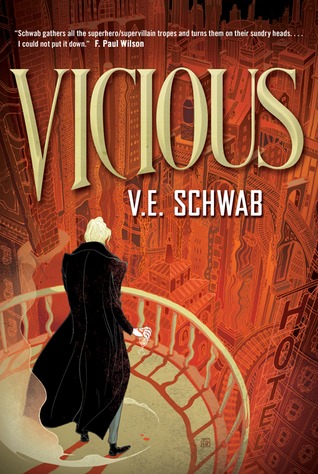

This is Victor, turning his back on you.
Lissa Price:
I will go with the Master from the David Tennant version of Dr Who. 


The Master, from Dr Who. Source
"This? Oh, it's just a fork. Trust me."
E.C. Myers:
I am going with General Zod, specifically from the film Superman II. He isn't the worst villain, but he's definitely evil and ambitious and a match for Supes. He's also inadvertently funny and entertaining. "Kneel before Zod" is classic, and there's this great moment in the film where he's being interviewed on TV and he ends it by using his own name as an exclamation: "Zod!"
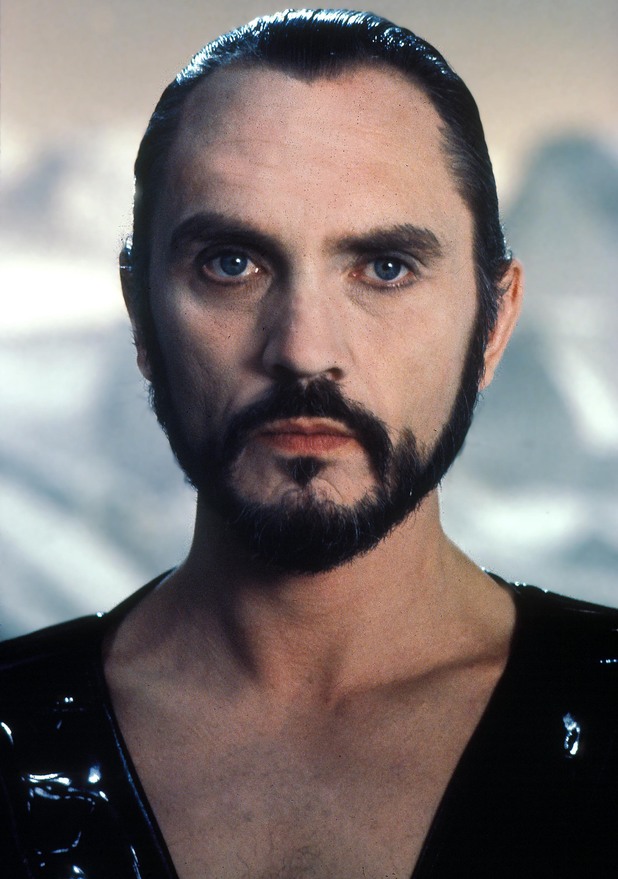

General Zod. "Kneel before my superlative facial hair stylings."
Lydia Kang:
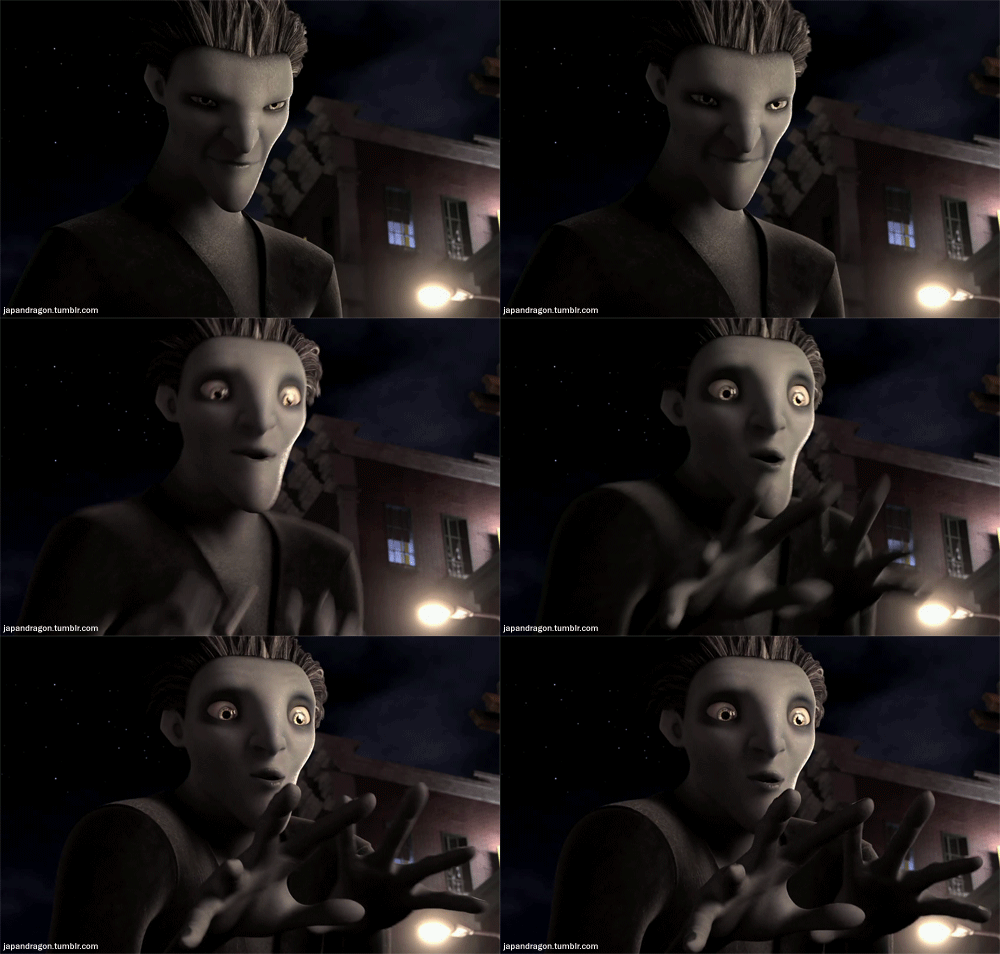
I would say Loki from Thor. He's so devilishly evil but with a squishy heart inside. And then there's Khan, from Star Trek into Darkness. I also had a major villain crush on Pitch, from Rise of the Guardians. That scratchy voice was too much. Who doesn't want to strive to just exist? I could go on...


Here's Loki looking SO evil. Um. Wait. Let me try another. 
Hmm. Evil looks too good. Let's try another.
"BOO!"
Source
That's better!

So do you have a favorite villain? Tell us who and why in the comments below!


Review of IN A HANDFUL OF DUST by Mindy McGinnis

Okay, so it's time for another book review! This time I got to read an early copy of IN A HANDFUL OF DUST by fellow Leaguer, Mindy McGinnis. This is a companion novel to Mindy's first book, NOT A DROP TO DRINK. And I'm a real fan of companion novels, having written two myself.

With DUST, we get to follow Lucy, who was a child in the first book. Her caretaker and stand-in mother is Lynn, who was the teen narrator in DRINK. If you liked the format of THE FOREST OF HANDS AND TEETH and it's companion THE DEAD TOSSED WAVES, you'll enjoy the companion style of DUST to DRINK.

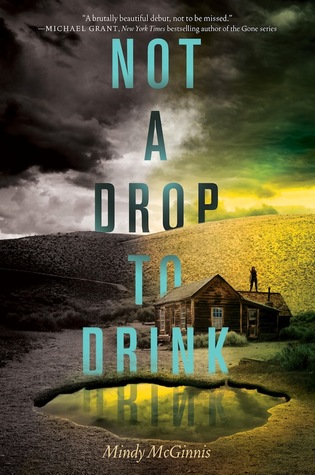
About NOT A DROP TO DRINK: Sixteen-year-old Lynn will do anything to protect her valuable water source, but the arrival of new neighbors forces her to reconsider her attitudes. With evocative, spare language, and incredible drama, danger, and romance, debut author McGinnis depicts one girl's unwavering efforts to survive in a harsh frontier-like future.

"A high-quality survivalist story for readers who enjoy internal story arcs as well as external dangers." (Kirkus Reviews)
About IN A HANDFUL OF DUST: In a Handful of Dust is set ten years after the first novel, Not a Drop to Drink, as a dangerous disease strikes the community where teenage Lucy lives. When her adoptive mother, Lynn, takes Lucy away from their home and friends in order to protect her, Lucy struggles to figure out what home means. During their journey west to find a new life, the two face nature's challenges, including hunger, mountains, and deserts.

Why You Should Read It:
1. If you're a fan of dystopian novels, this series has a fresh twist, taking us back to the frontier times. I just read a historical novel set in the harsh climate of Montana, and DUST and DRINK has this distinct feel of the harshness of a "wild land" where anything goes and there's no law.

So it's unique. There's no oppressive government. There's not a "utopian" feel that a lot of other dystopian novels/series have. So if you haven't picked these novels up yet, you should! You'll get something fresh and different.

2. IN A HANDFUL OF DUST is a continuation of the story started in DRINK, but it has a story arc of it's own. So don't feel like you need to start with the first book. Mindy does a great job of letting readers know what's happened without dragging down the current plot.

3. The premise of the series is that there's hardly any water. Being a lover of the ocean, I really identified with Lucy, who wants to go to California, where she's heard there are desalination plants. Lynn--the older, more seasoned woman--decides to accompany her, but really this is Lucy's fight in the wilderness. And there were some pretty terrible situations--betrayals from a friend, gun fights, people wanting Lucy for her ability, treacherous mountains to climb (literally!), and reaching a city that doesn't have any more water than they had back home--that Lucy had to overcome in her quest to get to California.

I think most of us have had our own "mountains to climb" from time to time in our lives, and this adventure story of a cross-country trip in pursuit of a dream (even if that dream is simply having clean water to drink!) is appealing.

So be sure to buy these books today! Here's where you can find IN A HANDFUL OF DUST:


We have a dual Book Birthday at the League!

We are excited to have TWO fantastic books written by Leaguers releasing today! IN A HANDFUL OF DUST by Mindy McGinnis and THE FORBIDDEN FLATS by Peggy Eddleman.

Check them out:


The only thing bigger than the world is fear.

Lucy’s life by the pond has always been full. She has water and friends, laughter and the love of her adoptive mother, Lynn, who has made sure that Lucy’s childhood was very different from her own. Yet it seems Lucy’s future is settled already—a house, a man, children, and a water source—and anything beyond their life by the pond is beyond reach.

When disease burns through their community, the once life-saving water of the pond might be the source of what’s killing them now. Rumors of desalinization plants in California have lingered in Lynn’s mind, and the prospect of a “normal” life for Lucy sets the two of them on an epic journey west to face new dangers: hunger, mountains, deserts, betrayal, and the perils of a world so vast that Lucy fears she could be lost forever, only to disappear in a handful of dust.

In this companion to Not a Drop to Drink, Mindy McGinnis thrillingly combines the heart-swelling hope of a journey, the challenges of establishing your own place in the world, and the gripping physical danger of nature in a futuristic frontier.


Twelve-year-old Hope has always felt a little different from everyone else who lives in White Rock. She tries hard, but she doesn’t always think before she acts. She takes big risks. Sometimes her risks pay off, but sometimes they fail. Sometimes she fails.

Hope knows that the most dangerous thing about living in White Rock is that it’s so close to the deadly Bomb’s Breath—the invisible, fifteen-foot-thick band of compressed air that’s hovered over the earth since the Green Bombs of World War III. The citizens of White Rock live in fear of the Bomb’s Breath. Only Hope has figured out a way to go through it—and lived to tell the tale.

But when a massive tremor rips across the earth, the Bomb’s Breath begins to lower over White Rock. It’s up to Hope and her friends Brock and Aaren to make the dangerous journey far from home across the bandit-ridden Forbidden Flats to the wilds of the Rocky Mountains and obtain the one thing that may be able to stop it—before the Bomb’s Breath sinks too far and destroys them all. This time, Hope can’t fail.


I Will Show You the Awesome IN A HANDFUL OF DUST

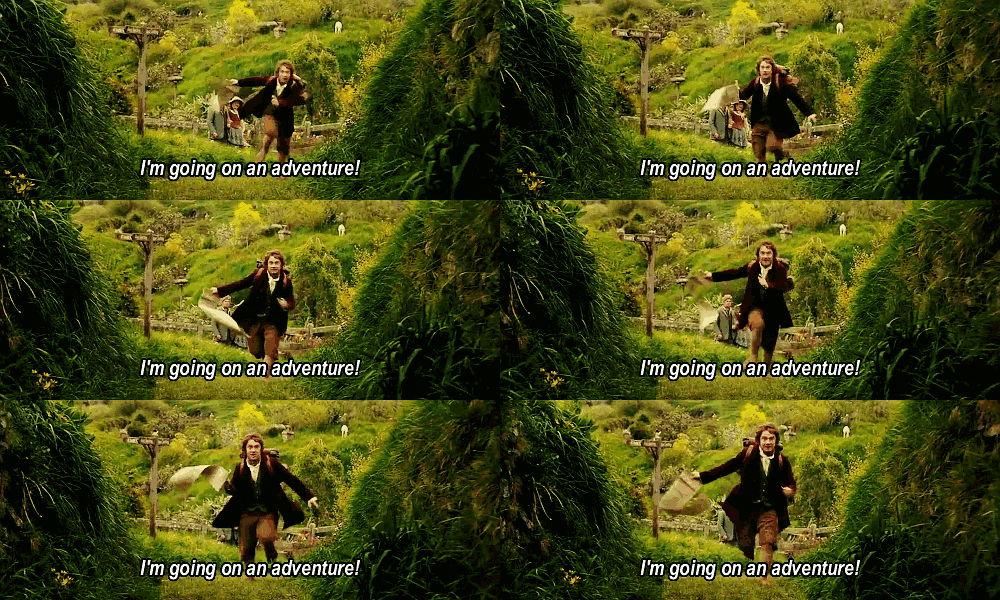
Tomorrow, September 23rd, is a special day, and not just because it’s the day that Frodo leaves Bag End in The Fellowship of the Ring.  Tomorrow, you will be able to get your hot little hands on Mindy McGinnis’s IN A HANDFUL OF DUST.  You will be able to crack open the spine.  You will be able to smell the freshly printed pages.  And even better, you will get to find out what happens to Lynn, our favorite rifle-toting badass from NOT A DROP TO DRINK.


Six Additional Reasons You Want What This Book’s Got:


1. It’s like The Road for teens and also with more shooting.


2. Lynn and Lucy prove that female friendship can be just as complex and riveting as any love story.


3. It’s a journey story!  Sort of like The Fellowship of the Ring but with more shooting.  Or The Gunslinger but with young women instead of dudes and also more shooting.


4. The parched American Midwest is bleak, beautiful and unforgettable.


5. Tons of gorgeous poetry allusions:


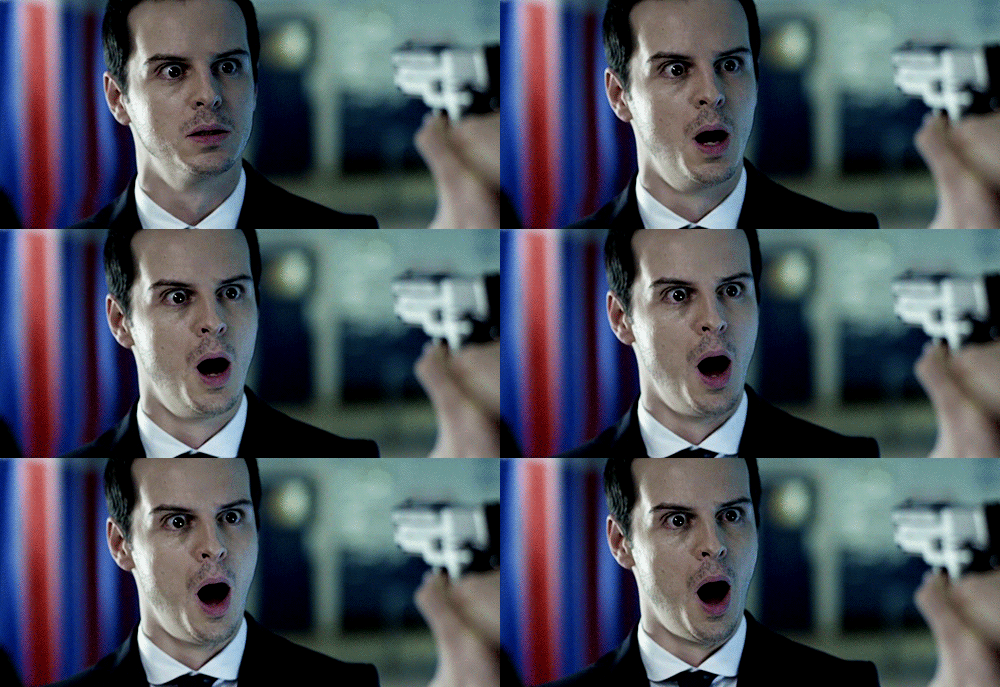
6. There is a Plot Twist.  But I can’t tell you what it is.  But it made me do this:


Then, by the end:


So, in conclusion: IN A HANDFUL OF DUST = AMAZEPANTS.

If you're extra curious, here's the blurb:

Fans of classic frontier survival stories as well as readers of dystopian literature will enjoy this futuristic story about an epic cross-country journey. In a Handful of Dust is set ten years after the first novel, Not a Drop to Drink, as a dangerous disease strikes the community where teenage Lucy lives. When her adoptive mother, Lynn, takes Lucy away from their home and friends in order to protect her, Lucy struggles to figure out what home means. During their journey west to find a new life, the two face nature's challenges, including hunger, mountains, and deserts.
New York Times bestselling author Michael Grant says Not a Drop to Drink is a debut "not to be missed," and this companion title is full of Mindy McGinnis's evocative, spare language matched with incredible drama and danger. In a Handful of Dust is perfect for fans of PartialsEnclave, and Legend.

And here's where you can find it:


Get Out Of the Bathtub! There's A Storm Coming!

I can't tell you how many times I've heard this in my life.

Where I grew up you can see for miles over flat fields. Anytime farm chores left a film on your skin and thunderheads were piling up, you ran for the house so that you didn't have to smell yourself while eating dinner. Now that I'm older - and supposedly wiser - I've found out that a lot of the things I learned when I was a kid weren't necessarily true. Try most of American history... but that's another post.

So while brainstorming for new book ideas I found myself ruminating on this old idea. Did I really need to leap out of the bathtub every time my mom yelled at me, or was she just being overly protective? A little research was all it took to find out that she was no helicopter parent and that Norman Bates is not the only thing to be scared of while getting clean.
  • Yes: You can be struck be lightning while in the shower. When lightning strikes a home it can travel through plumbing, metal pipes delivering that electricity directly to anyone who happens to be holding onto them at the time. Not only that, but the water itself carries impurities that help conduct electricity.
  • Hold the Phone: Actually, don't. For everyone who still has a landline, those conduct lightning blasts as well. Right into your ear. 
  • Those Dishes Will Keep & Your Breath Is Not That Bad : Yeah, don't do dishes during a thunderstorm either. Or brush your teeth. Honestly you should probably just follow the dog. Go under the bed and whimper for a little while.
It turns out that mother nature really can be quite vengeful, and my own wasn't as paranoid as I thought.


An Iron Rod To The Head Can Really Change Your Perspective

I'm fascinated by the human brain. Deeply, deeply fascinated. Our understanding of the rest of our bodies is pretty thorough, but the organ that makes us US, that commands our speech and movement, our personalities and intelligence we're still drawing a pretty big blank on. Yes, we're learning. We're mapping our brains and using the technology at our fingertips to make strides, but one of the larger steps toward knowing more about our brains came in 1848.

Phineas Gage was a railroad worker whose job involved setting blasts to make way through rock for the new lines. He used a tamping iron - a metal rod three feet long - to tamp charges down before igniting them. On September 13, 1848 someone messed up. A hole had been bored into the rock, the powder had gone in, and (Gage thought) so had the sand that his tamping iron packs. But the sand wasn't there, and when Gage struck the gunpowder it ignited, sending his tamping iron through his skull. It entered below his left eye socket and exited through the top of his head.

Yep, that's gross.

If you want to see a digital reconstruction of the accident (skull only, no gore) take a look at this video from the New England Journal of Medicine. I personally love that they added Gage's jaw dropping open in shock as the tamping iron explodes his eye socket.

Gage is famous not because he had a tamping iron blown through his head. He's famous because he lived even though part of his frontal lobe exited along with the tamping iron. Gage not only lived, but was walking and speaking right after the accident. His workmen carted him to the town doctor, to whom he supposedly said, "Here's work enough for you, doctor."

Yes, he even had a sense of humor about it all.

But, not for long. Though Gage lived through the accident, his personality showed damage long after the physical healing was finished. Gage had been a hard worker, an intelligent foreman and a pleasant person. Post-accident Gage was a shadow of his former self. The doctor who treated him initially, Dr. John Martin, followed Gage's progress with interest and documented the personality change:
The equilibrium or balance, so to speak, between his intellectual faculties and animal propensities, seems to have been destroyed. He is fitful, irreverent, indulging at times in the grossest profanity (which was not previously his custom), manifesting but little deference for his fellows, impatient of restraint or advice when it conflicts with his desires, at times pertinaciously obstinate, yet capricious and vacillating, devising many plans of future operations, which are no sooner arranged than they are abandoned in turn for others appearing more feasible. A child in his intellectual capacity and manifestations, he has the animal passions of a strong man. Previous to his injury, although untrained in the schools, he possessed a well-balanced mind, and was looked upon by those who knew him as a shrewd, smart businessman, very energetic and persistent in executing all his plans of operation. In this regard his mind was radically changed, so decidedly that his friends and acquaintances said he was 'no longer Gage.'
While Phineas' accident was life-changing in a bad way, it led to tremendous gains in the emerging science of neurology. Scientists were just beginning to understand that different areas of the brain served different purposes, and while they didn't quite grasp how this worked (enjoy this amusing early phrenology chart), Gage's trauma taught them that the frontal cortex was heavily involved in personality and social reasoning.

Gage died during an epileptic fit thirteen years after the tamping rod accident. His skull and tamping iron are in the Harvard University School of Medicine, if you want to go see them.

Gage's story is both sad and amazing, one that's always captured my attention. That a iron rod can pass through the human brain and that brain continue to function might sound like fiction, but it's not.

It's just science.


In Defense of Insta-Love

I know, you're probably looking at the title and thinking that there's no way Mindy is the author of this blog post. Mindy, who is so clearly acerbic and a downright instigator when it comes to the demise of the HEA. But, I think this makes me the perfect person to write in defense of insta-love in YA, because you can rest assured that I'm not being reactionary in regards to my own book. (You'll notice that Lynn and Eli don't ever say, "I love you." Why? Because- ick).

So, with that pre-disposition of ick in mind, I can still honestly defend the presence of insta-love in YA. Because even though I'm an old, bitter, cautious woman now, I haven't always been. Yes, Mindy used to fall in love, often and easily, just like the vast majority of teens everywhere... which is who YA is being written for in the first place.

Yes, teens fall in love quickly. And there's plenty of evidence to show that they really can't help it. This article from National Geographic regarding the maturation of the teen brain goes into detail regarding their risk-taking, but the last section focuses on how their changing brains function socially:
The teen brain is similarly attuned to oxytocin, another neural hormone, which (among other things) makes social connections in particular more rewarding. The neural networks and dynamics associated with general reward and social interactions overlap heavily. Engage one, and you often engage the other. Engage them during adolescence, and you light a fire.
Yep, it's true. Love is just better when you're young. Their brains are chemically predisposed to fall in love, and anyone who spends more than the average amount of time around teens can attest to this. They enter into emotionally-drenched connections with someone they truly believe is their soul mate in December, then discover in February that it's actually the girl from English class they're into. And the truth is - they probably are. I don't think it diminishes the weight or value of their love to fall into it so easily and so quickly when they are biologically predisposed to behave in this manner.

What I don't like to see in any genre is insta-love that happens as an excuse for lazy writing, with zero spark between the characters and a simple forced-upon-the-reader: These two are in love now. Fact. Most of the time when I see people complaining about insta-love it's because the writer didn't sell the relationship, not because the relationship shouldn't exist in the first place.

My other beef has nothing to do with insta-love, it's insta-stability. I firmly believe teens do fall in insta-love, but they also fall out just as quickly. It's when I see teens portrayed as meeting their one-and-only and being-blind-to-all-others-for-an-extended-period-of-time-with-no-question-of-the-happiness-that-will-extend-into-eternity that I start to get a bit pissy.

Sorry, I don't buy that.

In fact, I don't care how old the characters are.


How I Am Similar to A Piggy Bank, or What To Do About Those Bothersome Free-Floating Crystals In Your Head

I had the amazing experience of being on the Fall Dark Days tour this past month. Columbus to Vegas, Vegas to Denver, Denver to Houston, Houston to Austin, Austin to Dallas, and Dallas to Columbus... in four days. Yep. Six flights in four days, and for the first two I had a head cold that had dug in like virus claim jumpers on the high-profile real estate of my sinus cavities. Denver took care of the head cold, but it seems all the flights left a little something to remember them by...

... like a free floating calcium crystal in my ear canal.

I started feeling slightly dizzy on and off during the tour, but we were exhausted and I thought nothing of it. I chalked up the continued vertigo spells to more tiredness as I collapsed for the weekend once I returned home, but two weeks later I still wouldn't have passed a State Trooper line-walking test even if I was dead sober. Last weekend while trying to operate an apple-picker I ended up on my ass surrounded by bumble bees, and so I went with the logical assumption that I had a brain tumor and was about to die.

Which, honestly, makes a lot more sense than imagining that there was a free floating crystal in my ear canal, right?

I went to WebMD to plug in my symptoms, because that's what all the neurotic people do first rather than call an actual doctor. Ironically, every other time I've consulted WebMD it's informed me that I probably have a brain tumor, yet when I went to it with brain-tumory symptoms it let me know that there were floating crystals in my head.

Yep. Little calcium growths in your otolith organs (don't try to get in there and clean them out with a Q-Tip, we're talking way in there) can get knocked loose and fall even further into the murky depths of your head to your semicircular canal where it plops into the liquid that helps you keep your balance. It's kind like a level inside your head - except it isn't working.

So what do we do about this non-working head leveler? Funny you should ask. Basically, your doctor can perform the Epley maneuver, a series of movements designed to get that little calcium crystal out of your head-level-liquid and back into the inner ear where it belongs. But of course you can't see it, so you don't really know for sure if it worked.

I'm reminded of that one last penny rattling inside of a piggy bank, and all my shaking efforts to dislodge the damn thing.

Why am I telling you this? Because it's interesting, and because the human body never ceases to amaze me. We have all these complicated crevices with magical sounding names and ALSO CRYSTALS IN OUR SKULLS THAT LET US WALK.

What the hell?

Who needs fiction?


Why everyone should read NOT A DROP TO DRINK by Mindy McGinnis

I was lucky enough to get an ARC of Mindy McGinnis's NOT A DROP TO DRINK (HarperCollins/Katherine Tegen Books) at ALA this summer, and even though I read the story months ago, it stuck with me. The characters, the mood, the setting--everything. In my opinion, this survival tale will resonate with all kinds of readers: male or female, young or old. So to celebrate the book's release last Tuesday, here's my list of reasons why everyone should read NOT A DROP TO DRINK.


1)  Because the story is reminiscent of one of those awesome old western movies, where the gunslinger is forced to make a final stand and protect his homestead--only, in this case, the setting is futuristic and the gunslinger is a young girl (DOUBLE WIN).

2)  Because Lynn, the main character, is a badass, but not in the conventional, superhero way. She's believably tough and determined, since she learns the tools necessary for surviving under the direst of circumstances. Hunt for food? Check. Defend her home? Check. Do everything she can to protect her loved ones? You bet.  But it's not just her badassery that's admirable--it's also that ultimately, she's got enough heart and inner strength to learn to let other people in, despite being taught to shoot first and ask questions later.

3) Because it's a surefire way to make you feel better about your own crappy situation. I mean, think your life is rough? Wait until you experience Lynn's.

4) Because this book doesn't pull any punches. There's no wimping out, no skirting the tough choices. The author remains true to the bleak circumstances of the story, which means Lynn and the characters around her suffer, greatly, as they try to make it in a very scary environment.

5) Because this is not a romance masquerading as a survival story--not even close. NOT A DROP TO DRINK is a survival story with heart.

6) Because you can't help but hum Beyonce's "I'm a Survivor" as you flip the pages... (okay, maybe that's just me)

7) And finally, because Mindy is awesome and hilarious, she can skin a deer, and she gives good arm. Blue arm, that is. (sorry, I just had to work that in. Vlog reference here)


Now, go out and pick up your own copy of NOT A DROP TO DRINK and enjoy! Also, tell us--
besides Lynn, who are some of your favorite survivors from books, TVs or movies?


Why Not A Drop to Drink should be your next read

On Tuesday, Mindy's editor tweeted a challenge. We were supposed to guess what Mindy sent to Harper to celebrate the release of NOT A DROP TO DRINK. Most guessed some sort of baked good (because that would be normal), but I've met Mindy, and I know that Mindy goes all in. I guessed "deer meat" (it is in the book, so not as weird of a guess as you might think) and the answer was "venison steaks" so close enough.

I tell this anecdote only to illustrate how dedicated Mindy is to the world that she's built in her debut novel. (And maybe to brag a bit for getting the right answer - ha!). A world where water is more precious than gold is brutal indeed and Lynn is absolutely a product of such an environment. Lynn is the type who shoots first and asks questions later, and after this novel, she shot to the top of my "survive the apocalypse dream team."


So yeah, if you enjoy strong female characters, you'll love NOT A DROP TO DRINK. But what makes the novel incredibly effective is Lynn slowly discovering the difference between merely surviving and really living. Mindy sets this up perfectly, introducing a rich family from the city who is not cut out to live in the wild. The way that Lynn builds a relationship with them is a thing of beauty.

I am generally not a crier, but Mindy made me care so much about these characters, I was a sobbing mess by the end.  And that's why NOT A DROP TO DRINK gets the Zombie Chicken Merit Badge for writing as well as a place on my favorites shelf. (See index of all my dystopian reviews on my personal blog Presenting Lenore)

And now - who wants a venison steak?


NOT A DROP TO DRINK Release!


I'm so excited for the release of NOT A DROP TO DRINK by our League member, Mindy McGinnis. Why?

1. Authenticity. I'm a sucker for a good survival story. The details are so crisp and true that you can practically taste the canned vegetables and the smell the gunpowder in the air. It's like you're there, only you're SO glad you're not, since living in Lynn's world would be awful. Because I like daily showers and not having to worry about coyotes attacking me.

2. Thirst & Hunger. You will be thirsty reading this. I mean, really thirsty. And hungry. And any book that makes you say "I need water or I'm going to die reading the next ten pages" or "smoked deer sounds pretty good right now" is a book that you should read. Immediately.

3. The Turn. You know what I'm talking about. You learn about a character; their lives change, and somewhere along the line, they change too, in a profound way. But that metamorphosis, when done well, is often the one thing that makes me remember a book forever.

4. It made me do this:


Yes, I canned home made spaghetti sauce just in case, you know, water becomes scarce and I have to live off the land (aka my 5 foot vegetable garden plot.) Mindy's book has got me training for the end of the world. See what this book has done to me?

*runs off to make Korean BBQ beef jerky*

About NOT A DROP TO DRINK:

Fans of classic frontier survival stories as well as readers of dystopian literature will enjoy this futuristic story where water is worth more than gold.


Teenage Lynn has been taught to defend her pond against every threat: drought, a snowless winter, coyotes, and, most important, people looking for a drink. She makes sure anyone who comes near the pond leaves thirsty or doesn't leave at all.
Confident in her own abilities, Lynn has no use for the world beyond the nearby fields and forest. But when strangers appear, the mysterious footprints by the pond, the nighttime threats, and the gunshots make it all too clear Lynn has exactly what they want, and they won't stop until they get it. . . .
New York Times bestselling author Michael Grant says Not a Drop to Drink is a debut "not to be missed." With evocative, spare language and incredible drama, danger, and romance, Mindy McGinnis depicts one girl's journey in a frontierlike world not so different from our own.


****
Available on Amazon, Barnes and Noble, and IndieBound

Follow Mindy on Twitter, find her book on Goodreads,  and check out her website!

All The Stories Have Been Told... Even The Dialogue

I love being a media consumer. And man, do I consume. If media had calories I'd be in a circus somewhere. I read about 80 books a year (not counting manuscripts I read for critique partners) I binge watch cable shows when they come out on DVD because I won't pay for television, and the number at the bottom of my iTunes library screen is really, really big. And while I fully believe that reading, watching, and listening is only one step behind actually putting your fingers to the keys and writing, there is a downside.

And that downside is that I always know what's going to happen.

I've been told for years that all the stories are exhausted, we're just recasting them in a new mold. When I was younger I didn't believe that, but now I see that's only because I hadn't been exposed to many of the already-manufactured stories in existence. Now that my horizons have expanded I can see it's pretty much the case.

I know. I always know. My brain has devoured so many plot lines, characters, story arcs, and fake conversations that it's almost impossible for me to get the same enjoyment out of books, movies, and TV shows that I could when I was younger. I'm at the disgusting point where I can predict dialogue. The boyfriend and I went to see World War Z (which, coincidentally, I totally enjoyed) and there were three different points where I turned to him and said the next line of dialogue before it happened.

I'm really annoying to go to the movies with, by the way.

There are benefits though - I know what people expect when they're reading my stories, so I veer off somewhere else. I recently met Michael Grant (GONE) at ALA. He blurbed my book for me (I'm still in shock) and when we met he told me one of the things that hooked him was that NOT A DROP TO DRINK surprised him. He said he thought he knew where it was going and then... it didn't. This was one of the happier moments in my life, by the way.

And another up side is that when I'm reading and someone knocks me back - it recently happened with Kate Karyus Quinn's ANOTHER LITTLE PIECE and Stephanie Kuehn's CHARM & STRANGE - I take a hard look at what they did that broke the mold... and then I try to figure out how to do that, in my own way.


Science Fiction is Now, But Cars Are Still Ugly

If you follow my personal blog, Writer, Writer, Pants on Fire, you know that I recently lost an entire outbuilding to a massive storm. Shortly thereafter the transmission burnt out on my car and I was starting to feel like a female Charlie Brown. It’s time for a new chicken-coop, and a new car. The science fiction aspect is definitely more applicable to the car than the chickens.

First of all, I dislike cars – and not for the reasons you think. Yes, I love nature. Yes, I like animals. People are OK. Cars manage to kill all these things. But that’s not why I don’t like them.

I don’t like cars because they’re so damn boring.

They all look like… cars. Even the cars with an ultra-modern design seem to be having an identity crisis. Are you an SUV? Are you a car? Are you a station wagon? Are you a truck? So many of the models I’ve been looking at as I shop don’t really seem to know. They’re like, Check me out, I’m ALL these things, and you can be too!

Well, I don’t want to be. I want a vehicle that’s confident in the fact that it’s a mini-van, or an SUV, or a truck. Just BE that thing, man. I drove a PT Cruiser for a decade because I liked that it was reminiscent of 1940’s cars. It was funky, and different from every other box on wheels.

I still don’t know what I want, and am waiting patiently to fall in love. In the meantime, I’m driving my parent’s Lincoln Navigator *cough* bus *cough* and am making lists of pros and cons.

And here’s the thing – despite the fact that I pretty much hate everything I see, I’m uniformly impressed by the technology in all of them. My car knows where I am, and can get me somewhere else. My car tells me when it needs oil, or the tire pressure is off. Cars can show you what’s behind you so that you don’t back into another car, an animal, a tree… or a person. It can call 911 for you if it feels that is necessary, save your life with an inflatable balloon, and auto-brake if a kid dashes into the road.

And most impressive- I can talk to my car. I tell it what to do, and it’s all, “Yeah, got it.”

What the hell? I mean, seriously – when I bought my Cruiser I was super excited because it was the first car I owned that had a CD player. My new car doesn’t even need a CD player. I tell it what I want to listen to, it confers with the phone, and they provide me with music. I’m impressed.

I know this is old news to everyone else. Yes, cars are cool and do awesome things, Mindy, you’re probably thinking. But this girl hasn’t bought a car in ten years, and a lot has changed since then. It makes me wonder what cars will be like in another ten years.

You know what I want? A car that cooks me supper for me.


The Science of Madness

I recently began researching insanity for the purposes of a WIP. I had some pre-conceived notions about what I would find, mainly in relation to the spotty medical care of the insane long ago. What I found was much more interesting than anything I believed I would dig up. It seems that we don't really understand a lot about insanity even today.

A lot of this has to do with the fact that the human brain and its workings remain as mysterious to us as the deep ocean blue. Doctors have been studying the brains of syphillitics, insomniacs, manic-depressives, serial killers, and even "normal" people, for a long time. Progress has certainly been made as far as understanding many, many things that we formerly were pretty clueless about, but it seems that every new discovery brings with it a massive revision of what we thought we knew twenty years ago... or even five years ago.

Madness and creativity have been good friends for a long time, something that anyone who has read more than a few paragraphs about some of the greats can tell you. But when I started digging around in the modern parameters for establishing schizophrenia, I became a little... well, I'll go ahead and use the word paranoid.

Because doctors have no way of documenting the internal processes of the insane, they have to rely on external behaviors to diagnose schizophrenia. Here's a general list of symptoms from the Mayo Clinic:

Positive Symptoms:
  • Delusions:  These beliefs are not based in reality and usually involve misinterpretation of perception or experience. They are the most common of schizophrenic symptoms.
  • Hallucinations:  These usually involve seeing or hearing things that don't exist, although hallucinations can be in any of the senses. Hearing voices is the most common hallucination among people with schizophrenia.
  • Thought Disorder:  Difficulty speaking and organizing thoughts may result in stopping speech midsentence or putting together meaningless words, sometimes known as word salad.
  • Disorganized Behavior:  This may show in a number of ways, ranging from childlike silliness to unpredictable agitation.

Negative Symptoms:
  • Loss of interest in everyday activities
  • Appearing to lack emotion
  • Reduced ability to plan or carry out activities
  • Neglect of personal hygiene
  • Social withdrawal
  • Loss of motivation

Yep. I dare any writer lost in the drafting process to look at these lists and defiantly declare they exhibit zero of these symptoms.

Now, be assured I'm not making light of mental illnesses. I've been doing some heavy research and learning a lot about the diagnosis (and mis-diagnosis) of mental illnesses both in the past, and not-so-distant years. There have been plenty of people institutionalized that were less outwardly insane than you or I. On the flip-side, some people who really need help don't get it because their symptoms aren't extreme enough to warrant intervention. 

In the end, the most glaring fact I've taken away from my research so far (and please, be aware that I know exactly how much of a layman I am) is that we really don't understand the human brain very well, even today.

If I've piqued your interest check out this recent TEDtalk about what we know - and what we don't.


Pros & Cons of Drinking Your Own Pee

One of the difficulties facing me when I started writing NOT A DROP TO DRINK was how to make the world believable. I think that's a huge leaping off point for any writer of Sci-Fi or Spec-Fic. How do we sell the world we pop our characters into? In my case, it wasn't one of those things where I could lackadaisically describe some trees (although trees are awesome) because the entire plot is based on the environment.

So, in a world where water is scarce and most of the water that does exist is cholera-ridden, how the hell is my character surviving? Well, I'm the biggest nerd you've ever met. So I researched my butt off in regards to H2O. I read about the history of water, I read about water ethics, and I read about water purification methods.

Yes, we can get salt out of water - good tip...
        ... but my character doesn't live near the sea.

Yes, you can drink your own pee...
        ... but not on a long term basis. Also, I wasn't sure I wanted DRINK to be identified as "that book where the chick drinks her own pee all the time."

Which left me with this - how is my character going to conceivably drink pond water in a world where I slashed the population down with cholera? Luckily, I'm a very invested nerd and I read National Geographic, where I discovered the SODIS method.

Yes! Science to the rescue! In short, the SODIS method involves putting water in clear plastic bottles and exposing them to at least six hours of sunlight. The UV-A rays in sunlight do the work, killing off viruses, bacteria, and parasites.

Gee, thanks sun. You rock.


A Slightly-Less-Awesome-Than-The-Book Vlog of MILA 2.0

I'm helping to celebrate this week's release of MILA 2.0 by Debra Driza by making a vlog highlighting some of the memorable moments in the book - don't worry, it's spoiler free!

It's also not quite as awesome as the book.

But I did my best.


Who Am I & Why Am I Here?

Common sense might lead you to believe that you, the reader, are the one asking that question of me, but no -- I'm actually asking that of myself. I'm not a big fan of being common, and being sensical is quite boring, so I decided to turn that little phrase on its head.

Q: Who am I? 

I keep having to double check, that I am in fact, still me. Surely some kind of body-hopping is suspect when a librarian from the Midwest spends a weekend walking around NYC with Katherine Tegen, and then checks her email to find an invitation from Beth Revis to join The League of Extraordinary Writers. 

I checked. I'm me. The mirror doesn't lie. (Although, I wouldn't mind it being a little less harsh with the honesty as I get a older, ahem. Mirror - you've been warned).

A: I'm Mindy McGinnis. 

A minor note - in NYC I introduce myself as Mindy McGinnis. At home in Ohio, I still introduce myself as my farmer-father's daughter. It carries more weight.

Q: Why Am I Here?

I wrote a book called NOT A DROP TO DRINK, a post-apocalyptic survival tale set in a world where freshwater is almost non-existent. But that's not the first book I've written. I've been writing, querying, and failing fantastically for about ten years, so you'll understand the degree of non-belief I've had to apply to my recent happiness. 

A: I'm not actually here. This is happening to someone else.

It's surprisingly easy to believe this. In my normal life I go to work, scoop cat litter, drive a decade-old car I rarely wash, and eat food that is really, really bad for me. Surely someone who can persevere through ten years of form rejections has the self-control to not pop Cadbury eggs like Tic-Tacs, right?

Apparently not.

So until reality comes along and bops me firmly on the head, Little Bunny Foo-Foo style, I'm going to continue to believe that I'm actually two people. 

That's healthy, right?


Guest Post: The Anything-Goes Attitude of Post-Apoc

Today I'm hosting the fabulous Mindy McGinnis, author of the forthcoming YA novel Not a Drop to Drink. I met Mindy in the querying trenches, and I can tell you she writes one excellent blog post. You are in for a treat, dear readers. To learn more about Mindy, check out her bio below.

 The Anything-Goes Attitude of Post-Apoc

A lot of people wonder where the sudden surge of dystopian and post-apocalyptic literature is coming from. I’ve got a fast and quick answer – our inner psyche. But we don’t have to ruminate on that. There’s a really fun explanation too, and that’s the fact that anything goes in a world we create on our own.

Dystopian and post-apocalyptic literature moves us beyond the “what-if” to the “who-are-we, really?” as individuals, and as a human race. If there weren’t police would we obey traffic laws? If there were no enforcement of a moral code would we kill each other without regret? And even more important – are you scared of heights?

That last one might feel like a left-field question, but it nipped me in my creative bud earlier this spring. My debut NOT A DROP TO DRINK (Katherine Tegen / Harper Collins, Fall 2013) revolves around a teen girl who protects her pond in a world where water is scarce by sniping strangers from her roof. I wanted a few nice aerial shots for what I hope will eventually develop into my trailer, so I looped a camera around my neck, dug out a ladder, and proceeded to freeze up about ten feet off the ground.

Yep. Ten feet. I had another solid ten to go, and then a scramble onto the shingles before I could even pretend to be the feral creature my MC is. And it totally didn’t happen. I meekly crept back down, put the ladder away, and got some nice still shots of the placid surface of my pond.

Now, if there had been some kind of motivating favor, like say, a tiger chasing me across my yard, then yes – I probably would’ve scurried on up the ladder. But there was no tiger, and I don’t feel the need to shoot people who take water from my pond, mainly because nobody does. Who the hell drinks pond water when you don’t have to?

But what if you did have to?

What if that pond was the only thing keeping me alive?

What kind of person survives in a world like that?

This is what I like about my little corner of the writing world, and have liked about it since I read THE STAND when I was… well, when I was too young to be reading it. Post-apoc and dystopian give writers the chance to throw our characters into a place that has only the laws we set, and then see how they eek out a life within those parameters.

They’re amazing people, these fictional characters that survive the brutal punishments we put them through. They’re little glimpses of a tougher, leaner human race that are asking the same questions we are, but in a different environment. Who am I? What do I stand for?
And while it may seem that I’ve circled back around to the inner-psyche, the more relevant question in most dystopian is – will I live through tomorrow? That kind of pressure hovering over each minute refines our characters, making every movement inform the reader.

When the difference between making it to the roof is losing a good photo-op or losing your foot to a tiger, minor inconveniences like fear are overlooked. Anything goes in our brave new worlds, and the things that go leave us with a stripped person, who we build back up with the blocks of our own making.

There’s so much creative freedom in dystopian, which is why we see such a glut of titles these days, each of them with it’s own unique world and characters. Enjoy them all, but don’t dismiss any of them as “been-there-done-that.”

Chances are, you haven’t.


Mindy McGinnis is a YA author and librarian. Her debut dystopian, NOT A DROP TO DRINK, will be available from Katherine Tegen / Harper Collins Fall, 2013. She blogs at Writer, Writer Pants on Fire and contributes to the group blogs From the Write AngleBook PregnantFriday the Thirteeners and The Lucky 13sYou can also find her on Twitter and Facebook