Showing posts with label writing process. Show all posts

Committing to the Shiny New Idea

Shiny new ideas can come at you with all sorts of speeds. There are the ones that slap you upside the head so fast, you twirl and forget your surroundings ("Groceries? Who cares! MUST WRITE NOW.") There are the slow brewing ones that squat like a frog in the corner of your brain, begging to be turned into something more majestic.

Either way, at some point, writers must commit to their new idea. Here are some of the steps I go through when deciding to spend the next months (or year? Years, even?) with the next novel.

What else is already out there?
Source: Giphy
Every story you write is uniquely yours. If you ask two people to write a story about paisley-patterned pixies that live in Greenland, they will still be different. But--I know that personally I don't like to write a novel if that type of story is already glutting the market. I want to write something that truly feels unique to me. How will I know readers will find it different? What can I add to the already plentiful number of beautifully written books out there? So I always take that into consideration.

What is my main character's journey going to be like?
Source: Giphy
So. The journey. There are lots of classic journeys that main characters go through. Will it be a classic hero's journey? How will the MC change and grow? What are the stakes? Are they important enough? When I ask these questions, I try to feel if this is a story I actually care to create, watch unfold, and be involved in.

How familiar am I with this genre?
Source: Giphy
I am a genre-hopping writer. CONTROL and CATALYST are firmly in the realm of science fiction, defined by the genetic manipulation and near future realities within it, but I've also written historical, urban fantasy, and have high fantasy and even more historical on my list of things to write. I've lived in YA but also dabble in MG. I always try to read lots of books when I'm entering into new territory, so I can get a feel for how other authors tackle them (also known as the most fun homework, EVER.) I know we hear the common phrase "Write what you know," but part of writing is about using our imaginations to expand into what we're unfamiliar with. However--if it's so unfamiliar that you're deeply uncomfortable in that territory, well. That's telling.
Can I speak the language?
Source: Giphy
This is really a research/brainstorming question. Before I can write a single word, I have to know what my characters are going to sound like, what they wear. I have to know what the buildings look like, if the food is spicy. I have to know about the politics of the time and the historical background--and I'm not just talking about writing historical novels. This is true for epic fantasy, and futuristic thrillers, and contemporary. If you can sit inside your world and really see it--you're ready to live there a while.

Who else lives here?
Source: Giphy
World building is one thing, but who else lives there? These are the people and animals and creatures that can really bring vibrancy to your world. A main character is nothing without the supporting cast. So I have to meet them and be just as entranced with them as the MC and world.

Am I in love with it?
Source: Giphy
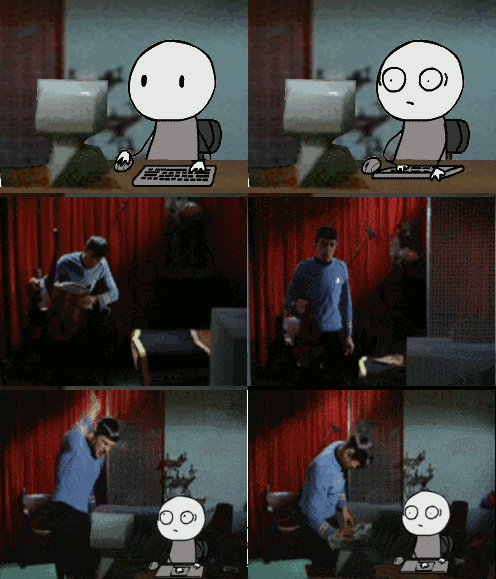
This is the biggest question of all. After all this work, am I still in love with it? Because to tell you the truth, I've never written a novel where my heart didn't flutter at the very concept of it. I can't explain why, but the spark sometimes disappears after fleshing it all out. Those books have never been written. However, if I'm still swooning over the idea, then Spock isn't allowed to destroy it all. I open up my Scrivener program and start writing page one. :)


Knowing when to let go

Anyone who has ever attempted to write a novel knows it is HARD WORK, but before you hit the Mid-Section Slump or the endless Redrafts of Doom, there is this beautiful, sparkly moment at the start of the process where you’re truly, madly, obsessively in love with the story. Life, which is normally painted in beige, is suddenly a vivid, glittering rainbow! It’s a great place to be.

But like all romances, when the honeymoon period is over and you start to see your book for the plot-hole riddled thing it really is, you’re faced with a difficult decision: struggle on or let it go?

How do you know when a book is the right one for you?

I’ve been noodling around on a new novel for the past…oh, three or four months…now, and at the start of the process I was happy with the idea. It had a strong hook, an interesting world and the potential for lots of steamy romance. On paper, it ticked all the boxes.

Then I started writing it.

And with every day that passed, I realized something. I wasn’t in love with the story and no matter how hard I tried, I simply couldn’t muster those feelings. 

I guess book relationships are similar to human relationships. No matter how perfect someone appears on their Match.com profile, if there's no spark, then no matter how much effort you put into the relationship you’ll never fall in love. All too often the people we fall in love with are the ones who don’t tick all the boxes; they’re either too short, or hate Buffy, or think Christopher Eccleston is the best Doctor (I mean, seriously, come on!). And yet they’re the ones who make our knees wobble and tummies fizz.

However, while I was working on said unloved project, I started thinking about another idea. At first I dismissed it, because on paper everything was wrong about it. But it wouldn’t go away. I couldn’t stop thinking about this new story; I became obsessed. My world became a glittery rainbow. I was enthusiastic and kept gushing about it to all my friends. I was in love.

So what was I to do now? Carry on writing my current project or admit it was time to let it go?

After much discussion with my critique partners, I finally made the difficult decision to stop writing the book. It’s not in my nature to give up on a project—I’ve written three novels under contract now, and they haven’t all been easy going. But I knew this was the right decision. And so, with trepid heart I contacted my agent and told her that my current book just wasn’t working for me. A few days later, we met up for lunch at the LBF and I explained my issues with the book and pitched my new idea to her. And boy, did I talk! I had an answer for every question; I knew exactly who the characters were, what their action and emotional arcs would be, what the world was like—heck, I even had an ending! By the end of the meeting she was as enthusiastic about the idea as I was and gave me her blessing to go ahead to write the partial.  

So now, that’s what I’m working on and I’ve never been happier. I don’t know what will come of the new idea; it may result in nothing. But at least, for now, I have love.  


write what you don't know

One of the most common pieces of writing advice we often hear as beginners is "Write what you know." But what does that even mean? And is it actually good advice?

If I had taken that suggestion literally, my first novel would have been about a man in his late twenties with a day job as a media coordinator at Lifetime Television who was writing a novel about the action-packed world of file transfers, video conversions, and women's programming. Riveting. Perhaps readers would have been drawn in by the rich cast of characters based on my wacky co-workers, friends, and family--who I'm sure would have been flattered to be included. You see the problem. Worse still, my second novel would have been exactly the same, and my third...

I read fiction for experiences completely different from my own, to see with other people's eyes, so why should writing fiction be any different? I love science fiction and fantasy because in the right hands, an author can make the impossible seem real.

But wait, I write young adult fiction, right? Then I should write about my old high school experiences... if only they hadn't been so dreadfully boring. Of course I do draw on my own memories--especially what it felt like to be a teenager--but in fiction, I can give myself, and other readers, something better. Something exciting. Something different. Something impossible.

So, how do you go about writing what you don't know? Research! This is one of my favorite parts of the writing process, where I buy and borrow lots of books on interesting new subjects, pass off watching movies and TV shows as "work," and talk to people.

The research is most exciting at the beginning, when I may not have written a single word yet and anything is still possible. I jot down notes and stick little Post-Its in the pages and just soak in all the new knowledge and see what my brain comes up with. I blurt out random, esoteric trivia to the people around me and start having conversations on topics they didn't think I knew anything about. Research can be seductive, because there's so much I don't know, the temptation is to just keep reading to find out just a little bit more. If you never start writing the book, it can remain forever perfect in your head. But when preparation becomes procrastination, it's time to start writing anyway, even though I don't yet know all the things. Especially because I don't know everything. After all, I didn't know how to write my first novel, so I thought I'd see if I could do it, and that turned out pretty well.

I'm researching all while writing that first draft and often through multiple revisions. There are always more books on the subject and related ones, and it fosters wonderful moments of discovery where a fact suddenly fits perfectly with the story--or sparks an entirely new idea. I'm also one of those authors who likes to read fiction related to the book I'm reading. I'm not worried about being subconsciously influenced by other authors, but I'm trying to avoid doing what others have done, or perhaps find a new or better approach. Basically, I like to immerse myself in the world of my characters to give my mind as much creative fodder as possible.

So what have I been reading for my work in progress? In Peggy's recent "What Are We Reading?" post, I was reading Ghost in the Wires, one of several books by the infamos hacker Kevin Mitnick. I've been reading various books and articles about social engineering, whistleblowers, and computer hacking, which led me to the marvelous, award-winning fantasy Alif the Unseen by G. Willow Wilson. I finally read The Girl with the Dragon Tattoo by Stieg Larsson and Homeland by Cory Doctorow. I spend a lot of time on Wikipedia and Google, and let's just say that I've probably been setting off some red flags with our friends, the NSA. (Hi, guys!) I also may have made some people nervous, like this weekend when I was reading articles about circumventing passwords on Macbooks while sitting in a coffee shop... next to a woman with a Macbook.

The biggest downside to being in full-on research mode is that reading all these books means my to-be-read pile of non-researchy books must wait a little longer--my reading time is finite (as is my time for everything else), and it's important to make sure I'm writing too.

I love being forced to write out of my comfort zone, to write what I don't know, because it makes me grow as an author. I have every intention of challenging myself to make each of my books different from the one before it--and hopefully share something new with readers in the process.

Building a Story from Atmosphere

You may not know this about me, but I rarely get to enjoy any part of autumn.  I have vicious seasonal allergies that turn my eyes into bloody, oozing, swollen slits and I generally can't breathe except for really noisily through my mouth.  So naturally, when everybody's skipping around, exclaiming over cider donuts and artisanal squash, I am generally uninterested.  I have my own private world of pain to inhabit, and I don't need any cider donuts there, just Allegra and Benadryl, thanks.

But this year I managed to outlast the ragweed somehow, and when I came to in mid-October I realized something--I would get to see the fall!  And the thing about fall is that it's the perfect time to experience atmosphere.  Leaves blushing into bright red and orange, fog creeping between the trees, the sounds of dead leaves skittering on the sidewalk--for about three weeks now, I've been walking around in awe, like have you seen this?  It's SO COOL!  And then everybody is like, yes, we know.

This fall has made me aware of how in love with atmosphere I am and how it impacts my writing.  Atmosphere is the mood or feeling evoked by the setting and dialogue and themes, although when I'm gestating a new WIP, the atmosphere comes first for me, before anything else.  I know whether I want a world to feel lovely or haunted and gritty and then everything else starts falling into place.  What kind of world would give the impression of being haunted?  What kind of characters would live in that world?  How would this characters interact with it?

For some writers, the character comes first or the world or the story, but for me, every time, it's the mood.  The feeling I want to leave a reader with.

What comes first for you?


Writers and Superstitions

I used to believe in all sorts of superstitions when I was a kid. I threw salt over my shoulder if I spilled it, I avoided cracks in the sidewalk and walking under ladders, and a black cat anywhere in my vicinity made me nervous. I've outgrown all of those fears, but there are still some odd little rituals I follow. For instance, when an e-mail I've been waiting for finally pops into my inbox, I usually will open one or two other e-mails first, both to prepare myself for whatever news it contains and to try to psych out the universe: "See? It's not that important. I don't even care! It can wait until after I look at today's deals on geeky T-shirts."

Then there are some of my writer's quirks: I need a particular pen for taking notes and editing by hand (Uniball Vision Elite, blue-black ink, fine tip). I save and backup my work obsessively—but that's really just a good idea, for everyone. And, because of my novels, if I come across a U.S. quarter featuring Puerto Rico, I have to keep it. Can't spend it, nope. I have three or four of them now; in fact, I wear a silver proof of the PR territories quarter on a chain; it doesn't have any talismanic properties like Uncle Scrooge's Number 1 dime or anything, but I wanted to mark my first published novel in a special way, and I wasn't ready to commit to a tattoo.

Since today is Friday the 13th, I decided it would be fun to ask thirteen other authors about the superstitions and rituals they follow in their writing and personal lives. Some of their answers may surprise you!

Beth Revis, Shades of Earth (Across the Universe #3): This one's weird, but... I think spiders are good luck. When I was a little girl, I heard the story of how Robert the Bruce saw a spider spinning a web and, despite the fact that it kept being torn down, the spider kept trying, and that inspired the Bruce to not give up. Ever since then, I've really liked spiders, and if I'm worrying about something, spiders are my sign to not give up, or to attempt something that feels impossible.
Lydia Kang, Control: Sometimes I'll tie on a string bracelet with a charm to symbolize the book I'm working on. When the string finally wears down and breaks, I know that many months have gone by and usually, that first draft has been finished! If you ever meet me, you might see me wearing several bracelets for different books in different stages.
Mindy McGinnis, Not a Drop to Drink: The computer that I wrote Not a Drop to Drink on had to be retired, but I popped some of the keys off and kept them. My fingers had worn away the lettering on most of them, and there were grooves in quite a few of the keys where my fingers fit. I resisted updating my laptop for a long time because I didn't want to be separated from those keys that had typed the novel that landed me.
Lissa Price, Enders (Starters #2): I wear a dzi bead on a bracelet that helps me focus on my current writing goals.
Bethany Hagen, Landry Park: I tend to be superstitious about titles—I'm worried that if I give the book a real title before it's finished that it will curse it somehow. Or maybe that's just because I'm terrible at coming up with titles!
Lenore Appelhans, The Memory of After: I don't have writerly superstitions, but I will not look in a mirror in a dark room because of Bloody Mary. I'm a bit freaked out now for thinking about it at all. *shivers*
Peggy Eddleman, Sky Jumpers: I don't write at my desktop computer. I answer emails, blog, edit, pay bills, and a million other little things, but I can't write there. Words don't come, and if they do, they end up being deleted. Sometimes I tell myself it's the lack of natural light or the fact that my desk faces a blank wall. Mostly, though, it's because me and my laptop have a special writing connection. When my fingers are on that keyboard—no matter where in the world I happen to be—my brain knows to kick out words that are keepers.
K.D. McEntire, Lightbringer series: I don't have much in the way of superstitions when it comes to writing. I feel thankful whenever I have time to work, so I tend to jump right in. That said, there is a period of time each year (football season) when I'm given a weekly 4–5 hours at a stretch to work. Bless the man who invented Sunday Football, for my husband and sons go to Grandpa's house to watch the Chiefs, leaving me to get work done for a change. I like to buy a Panera chicken salad sandwich, a diet Dr Pepper, and I sit in the same spot with the same throw blanket. Then I crank. I am very cranky when robbed of those Sundays during the fall. I also refuse to buy lottery tickets unless I'm having a "good kid day." If I've yelled at the small ones I won't buy a ticket. No bad karma on lottery ticket days. ;-D
Diana Peterfreund, For Darkness Shows the Stars: I have a tough time starting a book until I have a title I love. For me it informs so much—the tone, the overarching theme, etc. I guess this ties in with my naming obsession in general.
Alethea Kontis, Hero: Okay, so here's my only writerly superstition. I got this from Sherrilyn Kenyon, and I hesitate to even mention it because I was raised by a Greek and a Catholic to whom superstition is ritual and just How We Live Our Lives. To speak something aloud—good or bad—is to tempt Fate...thus all the spitting, which is like knocking wood for good luck. Sherri says that "A writer on deadline never dies." When I told my mom this, she freaked out and spat...a lot. But I do believe this, despite knowing that deadlines exist everywhere and writers are immune to death no more than any other person on this earth...but when Sherri originally told me this, it rang with that certain air of truth I've never forgotten. Maybe that's why I didn't finish my manuscript before Dragon Con? Who knows...perhaps if I had, that fall would have been a lot worse...
Jenn Reese, Mirage (Above World #2): I love to buy myself a little something for each new novel—usually an inexpensive piece of jewelry from Etsy—but I can't buy the item until I'm halfway through writing the book. The jewelry is both a reward for making it that far and a promise to finish. When the draft is done, it becomes a talisman. I'll put it on again when it's time for revisions, copyedits, and proofs to help me get back to the right emotional place for the book.
Christian Schoon, Zenn Scarlet: So, we've got lotsa cats in our house. My wife has instructed me not to state the number publicly, lest we attract the attention of authorities. Vague clue: seven lg. litter boxes in service at all times, barely enuf. Anyway, if I get a cat lying on my lap during writing sessions (see above re: # of cats and thus high likelihood of cat-to-lap occurrence), I can't gently urge it to go lie someplace else (i.e., stand up or toss it to floor) until I finish the chapter I'm writing/editing/staring at vacantly w/ fingers poised. What'll happen if I violate the cat-overheating-waggly-bits area? I shudder to think. Anyway, that's my irrational fear and I'm stickin with it. (The thuggish cat currently on my lap looks up and gives me the "damn straight, skippy" look.)
Janet Edwards, Earth Girl: I’m not sure if I’m the only author who suffers from this, or if there are whole armies of us out there with the same secret fear, but at first I was a bit worried about telling people I was getting a book published. It seemed a bit unbelievable, and I had a weird idea that someone would suddenly leap out from behind me and say it was all a practical joke. Despite the fact the joke would now involve multiple publishers and a global internet conspiracy, I still tend to give a furtive look round for the practical joker before I risk telling people I’m an author.

Do you have any superstitions or rituals? Tell us about them in the comments!

Shiny, happy ideas and miserable writers

This weekend at the Decatur Book Festival, which was fabulous btw (thanks for asking), my panel was asked a lot of questions about ideas and writing and how to make an idea into a book.  When someone asks me where I get my ideas, I try to keep my eyes from rolling back in my head and give them a good answer.  But here's the truth, and it's something other writers know all too well:

I get ideas everywhere.

And I mean everywhere.  Vacuuming my house, on the highway, in the middle of a movie, talking with a friend, eating lentil soup, cleaning the wax from my ears.

I am under a constant barrage of ideas.  Writers don't see and hear things the same way nonwriters do.  All it takes is the right turn of phrase or casual dissemination of info and our minds start whirring, grinding out a plethora of what-ifs.

This might sound great, and most of the time when that Shiny, Happy Idea comes (SHI - ooh, that's a close one) along, I flirt with it, imagine who the characters are, what the cover will look like.  This honeymoon phase lasts anywhere from seconds to days until I think of my last SHI or another SHI pops into my head.

The best SHIs get a page of notes in a file titled backburner, some even have their own notebooks.  I'm always convinced my SHIs are marinating while I work on books that are under contract or deadline.  I'm positive I can write them all THIS YEAR and then I sit down to work on them and some of the shininess and happiness fades away, replaced with lots of questions.

Who are these characters?
What happens to them?
Most often—what was I thinking?

Sometimes that marinating time doesn't work it turns out.  Sometimes a SHI is just like all those shiny, happy objects that sparkle and catch our fancy in life but turn out to be pieces of junk.  It can be a miserable feeling when you sent down with your folder full of SHIs and come away feeling deflated.

What to do?

Pick a SHI and explore it.  Look for inspirational pics on Pinterest, find one and free write for 15 minutes.  Name your characters.  The problem with Shiny, Happy Ideas is that that's all they are–ideas. Books need a lot more than ideas.  They need bones and muscle and tissue, teeth and marrow.  Books need flesh and blood.  Wannabe writers create Shiny, Happy Ideas.  Writers create books.

So when you pull that Shiny, Happy Idea out and discover it's a little tarnished, decide if you want to chuck it back in the drawer or polish it up and remember, an idea kept in a drawer never becomes a book.


Growing a Story From A Seed

Where do ideas come from? There are too many answers to that question to count, but today I’m going to focus on giving you a snapshot of one way to tackle the getting of ideas.

I once heard Neil Gaiman say that everybody has ideas, but writers train themselves to notice them. To notice the playful daydreams and the ‘what ifs’ that float through all our brains on a daily basis. 

For me the ‘what if’, followed by the ‘what next’ are perhaps the most important parts of the daydream-to-idea-to-story sequence, and it all starts with a seed.

I recently saw an article about a group of medical specialists who have learned to oxygenate blood with an injection. It came about when one doctor watched a little girl die for lack of oxygen, and started thinking about ways to help her breathe that didn’t involve getting air down her windpipe. Now, they’re at the point of being able to oxygenate blood for up to half an hour via injection. A development like this, once widespread, could gift paramedics with the ability to save lives.

But, the article asked, what else could this mean? Could it help us spacewalk? Deep sea dive? What about climbing Everest without oxygen tanks? 

I thought this was fascinating, and for me, this is where the writer’s brain kicks in. The ‘what if’ is fascinating, and the ‘what next’ turns it into a story. What if we could spend extended periods of time underwater without any need for oxygen tanks? What next? Where would that lead? Could we explore underwater environments with greater ease? Could we look at ways to make them habitable? After all, with global warming, we’re looking at diminished landmass. Or we could take it in another direction—could I commute to work across the bay? All I’d need would be an injection, a waterproof suit to keep me dry, and some sort of propulsion. What would it be? An underwater motorbike? What would a city look like if rivers and bays became, essentially, roads? What sort of person might live there? Who could face an interesting dilemma?

The questions go on and on, and that’s before I even get to the question of spacewalks! Building a story is as simple—and as difficult—as that. A seed of an idea, and then a thousand iterations of ‘what if’ and ‘what next’, until just the right one comes along!

Post-Apocalyptic Jello and Caviar Delight


Today we have a guest post from Peggy Eddleman, author of Through the Bomb's Breath, a MG post-apocalyptic adventure coming in September 2013.  Learn more about Peggy below.

Let's say that you're a chef instead of a writer. (Just go with me on this one for a minute.) And you come up with the BEST recipe EVER. One that you love. You may have some different tastes in foods, but you know plenty of other people with different tastes in foods, and you know they will LOVE what you made, too. So you work hard and perfect your creation, which you've named Cheeto Peanut Butter Rainbow Jello Delight, Topped with Pineapple and Caviar. And it's truly incredible. You know not many people eat something like it every day, but if you could just get a major chain restaurant to put it on their menu, Cheeto Peanut Butter Rainbow Jello Delight, Topped with Pineapple and Caviar-loving people everywhere will cheer.

Permission granted by Mark Fickett, and by freestock.ca [CC-BY-SA-3.0], via Wikimedia Commons, and by Maks D. (My dinner) [CC-BY-SA-2.0], via Wikimedia Commons

So you present your perfected creation to Olive Garden, P.F. Changs, Texas Roadhouse, Red Lobster, Applebees, and The Cheesecake Factory.

Every single one of them turns you down.

And they all give you the same reason-- they don't think there's a big enough market for Cheeto Peanut Butter Rainbow Jello Delight, Topped with Pineapple and Caviar to justify carrying all the ingredients in all their restaurants, training all their chefs on how to make it, advertising, and reprinting all the menus.
And really, can you blame them? They are, after all, a business. If they put things on their menu that would lose them money, how are they supposed to stay afloat? So... does that mean Cheeto Peanut Butter Rainbow Jello Delight, Topped with Pineapple and Caviar is awful? Not necessarily. Should you just give up on your dream of people eating it?

Well, that depends on what, exactly, your dream is.

If your dream is to get people to eat Cheeto Peanut Butter Rainbow Jello Delight, Topped with Pineapple and Caviar, then no-- don't give up on it! There's not a lot of Cheeto Peanut Butter Rainbow Jello Delight, Topped with Pineapple and Caviar out there, and you'd be filling a niche that not many others are.You just need to find the right way to sell it. A food truck. A roadside stand. Your own restaurant. By mail order. 
If your dream is to get one of your creations in a major restaurant chain, then yes. Maybe it's time to re-evaluate the kinds of things you're submitting.
(You do get the analogy here, right?)

So what? You're telling me to give up on writing what I'm passionate
about and only write things that are commercial?!

Pshaw. Heck no. Let's take HUNGER GAMES / GREGOR THE OVERLANDER author Suzanne Collins for example. She is the daughter of a military officer, so hearing about wars and strategies and the harsh realities of what happens to children in a war-ridden country were common dinner table discussions. It fascinated her. She could've very easily taken that knowledge and fascination and written a Vietnam War narrative. Or went non-fiction, and wrote about the history behind war. She probably would've really enjoyed writing them, and some people would've really enjoyed reading them. They probably wouldn't have sold a ton of copies. Would that have been bad? ABSOLUTELY NOT. She would've been writing what she was passionate about and getting it out there for people to read. Instead, she chose to take that same knowledge and fascination and wrote something that would appeal to a much broader audience. She really enjoyed writing them, and people really enjoy reading them. Does that mean she sold out? ABSOLUTELY NOT. Because she was still writing what she was passionate about and getting it out there for people to read.

Everyone has different writing / publishing dreams and goals. Yours are more than likely exactly perfect for you. If your dream is about a specific creation, (a.k.a. a specific manuscript), no matter how outside of mainstream it is, then follow that dream! If it's about getting yours to a major publishing house, then take that fascination and passion burning inside of you, and look at what is also going to appeal to the broadest range of people.

Because like it or not, publishing is a business.

Peggy Eddleman is the author of THROUGH THE BOMB'S BREATH, a post-apocalyptic adventure for middle grade readers about a girl who can't invent, in a town where it's the most important thing. When bandits invade, inventing won't help, but the daring and risk-taking that usually gets her into trouble just might. THROUGH THE BOMB'S BREATH releases from Random House in September 2013. You can find out more about Peggy and her book at:


On Consistency

Okay, so I'm in that stage of writing where things have to be consistent. Not only plot items, but character relationships, reactions, world-building items, the full monty. And it's not just in a single book, but through an entire series, with one book which is completely unchangeable.

Let's define. Consistency: agreement, harmony, or compatibility, especially correspondence or uniformity among the parts of a complex thing.

I know, you're running scared. You should be. Because novels are COMPLEX THINGS. I think consistency is the hardest part of an author's job. We need our characters to act a certain way in a certain situation, but then we need them to do the opposite later on. That can't really happen, unless the arc the character has gone through is pretty big.

And in my novels, that's not the case. I'm a self-proclaimed "discovery writer" so I often have major consistency issues in my drafts. As I'm editing, I've devised a system to help me organize the chaos and achieve consistency.

The highlighter tool. It may seem lame, but I like all those pretty colors. I pick a color for language of a specific character and I highlight it. It's super-easy to check for overuse and consistency; simply make the zoom 20% and you can see 20 pages at a time to see if the color appears too much or not enough.

I repeat this highlighting process for relationships. Do they start and end the same way? If not, why not? Is the arc sufficient to support the change? If so--and that was the goal--yay!

I use the highlighter for many different aspects, but mainly to alert myself to things that need to stay consistent.

How do you stay consistent?

Writing Week: Everything I Need to Know, I Learned in Fifth Grade

No, really. I teach elementary school, and in the early years of my career, I taught a 5th grade writing class. In Utah, our students take a writing test called the Direct Writing Assessment. I graded them for 8 or 9 years.

Now that I write in addition to teach, I'm realizing that all that stuff I taught to ten-year-olds? Actually valuable. So let's fall back on our roots a little.

The Writing Process:
1. Pre-writing. Some of us spend a lot of time here, outlining and researching and filling out character sheets and whatnot. Some of spend very little time here, deciding instead that the discovery approach to writing is best.

2. Drafting. Some of us spend a lot of time here, getting in a few hundred words after a long day at the office. Some of us spend very little time here, getting as many pages written as fast as possible. But no matter what, in order to write a book, you have to, well, write the book.

3. Revisions. Some of us spend a lot of time here, fixing and rewriting and adding details. I'll admit that most of my writing time is spent actually revising or rewriting what I drafted. Others of us don't spend a lot of time here, because we nailed what we needed to from using an outline or by taking the time during the drafting stage to revise at the same time as write.

But everyone revises. Usually more than once. And more than twice. This is also the stage where most of us turn over our MS to trusted critique partners or beta readers. Then we do some more revisions based on their feedback.

4. Edits. I'll go on record and say that I think revising and editing are the same thing, but in 5th grade, this is where I would teach the students to make sure the punctuation was correct. The capitalization. The paragraphing. When I get to this stage in my novel-writing, I actually check for chapter placement, indentations, style, etc. It's really formatting more than editing.

What about you? Do you think revising and editing are the same thing?

5. Final draft. This is when you sit back and exhale loudly and say, "I'm done. I've done the best I can do, and I'm done."

Then the real fun begins. The querying. *wink*

What else is in your process? Does your process look like this at all? I'll be back another day to discuss the Six Traits of Writing that we use to grade the DWA.